Choosing the right emergency ladder starts with one simple question: how far is your safest exit from the ground? This ISOP fire escape ladder comparison explains the main differences between portable rope ladders for two-, three- and four-story homes, models with stand-off stabilizers, and longer evacuation sets with a safety belt or full-body harness.
Every home is different. Measure the real vertical distance from the window sill or balcony attachment point to a safe landing area—do not choose only by the number of floors. Check the opening, attachment point, wall obstacles and the needs of every person in the household.
ISOP fire escape ladder comparison chart
| ISOP ladder type | Typical height | Best for | Main advantage | Consider before buying |
|---|---|---|---|---|
| 13 ft / 4 m ladder with hooks | Second-story exits | Bedrooms, apartments, offices | Compact, portable and quick to deploy | Confirm that the hooks fit the intended sill or anchor point |
| 13 ft / 4 m ladder with stand-off stabilizers | Second-story exits | Walls where foot clearance matters | Stabilizers help hold the rungs away from the wall | Attach and inspect stabilizers in advance |
| 25 ft / 8 m rope ladder | Third-story routes | Taller homes and selected balconies | Longer reach while remaining foldable | Longer ladders require more controlled deployment and practice |
| 32 ft / 10 m ladder with harness options | Three- to four-story routes | High windows, balconies and evacuation planning | Available with additional belt or harness support | Training and a verified attachment point are essential |
| Wall-mounted system | Permanent escape point | Homes, offices and managed properties | Known location and fast access | Requires correct installation and periodic inspection |
1. Portable 13 ft ladder: a practical choice for second-story windows

The portable 13 ft ISOP rope ladder is intended for escape routes where the measured distance is compatible with its length. Its principal benefit is simplicity: it can be stored near the chosen exit and deployed only when required. Heavy-duty attachment hardware and anti-slip rungs are designed to support a controlled descent.
This model is a strong starting point for many two-story houses, but “two story” is not a measurement. A raised foundation, basement level, high sill or sloping ground can change the required length. Measure before ordering and make sure the ladder reaches a safe landing area without excessive unused length.
2. Stand-off stabilizers: better foot clearance against the wall
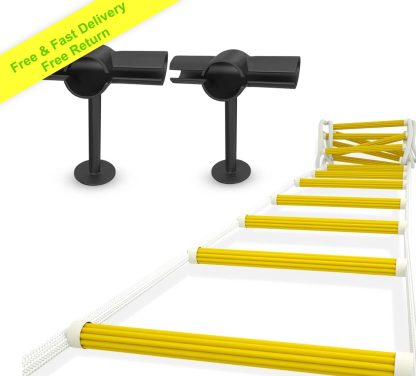
Rope ladders naturally rest close to the exterior wall. Stand-off stabilizers create space between selected rungs and the façade, making it easier to place a foot securely. They are especially useful where siding, window frames or other wall details make a flat-hanging ladder harder to climb.
Install the stabilizers before an emergency, then fold and store the ladder as a complete ready-to-use unit. Confirm that they do not catch on the storage bag and that the ladder can still pass cleanly through the chosen window.
3. 25 ft ladder: longer reach for many third-story escape plans
A 25 ft ISOP rope ladder offers substantially more reach than the standard two-story versions. It can suit many third-story windows, but only after measurement. Longer ladders take more time and space to deploy, so users should practice the sequence without climbing from height: open the window, secure the attachments, release the ladder outward and confirm that the route below is clear.
For children, older adults, pets or anyone with limited mobility, the escape plan should include assistance and an alternative whenever possible. A ladder is one component of a fire plan—not a replacement for smoke alarms, clear exits or emergency services.
4. 32 ft ladder with belt or harness: additional support for high routes
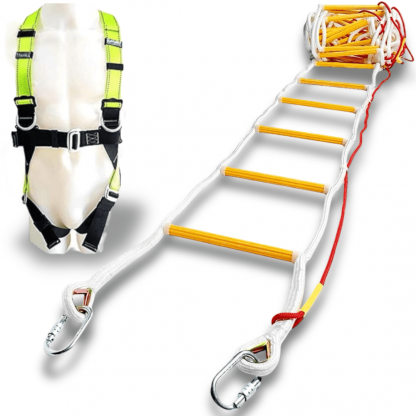
For a three- or four-story route, the 32 ft ISOP model provides longer reach and is offered in configurations with a safety belt or full-body harness. The extra equipment can add confidence and fall-protection support, but it also requires advance familiarization. Every user should understand how the selected system connects before it is ever needed.
Because high-level escape carries serious risk, verify the attachment point, route and local fire-safety requirements with a qualified professional. Product listings can change, so check the current page for the selected configuration, included components, technical data and certification details.
How to choose the correct ISOP ladder
This ISOP fire escape ladder comparison should be used together with your measured escape route and household fire plan.
- Measure the full route. Measure from the intended attachment point to a safe landing area.
- Inspect the opening. The window must open wide enough for the user and packed ladder.
- Match the attachment. Choose hooks, carabiners, anchors or a fixed system appropriate for the structure.
- Consider wall clearance. Stand-offs can make foot placement easier on a flat façade.
- Plan for every user. Account for children, older adults, pets and mobility limitations.
- Store it at the exit. Keep the ladder visible, dry, accessible and free from clutter.
- Practice safely. Rehearse deployment at ground level; never improvise a high-level test.
Shared ISOP features to compare
In this ISOP fire escape ladder comparison, attachment method, usable length and support accessories matter more than floor count alone.
Depending on the selected model, ISOP product pages describe flame-resistant rope construction, reinforced rung caps, anti-slip rung geometry, reusable compact storage, and heavy-duty carabiners or hooks. Some models are available with stand-off stabilizers, safety cords, belts or full-body harnesses. Always rely on the current listing for the exact contents and specifications of the variant you order.
Frequently asked questions
Is a 13 ft ladder always enough for a two-story home?
No. Floor labels are only a guide. Measure from the real attachment point to a safe landing surface and choose a length that covers that distance.
What is the benefit of stand-off stabilizers?
They hold selected rungs away from the wall, which can improve foot clearance and make the descent feel more stable.
Should I choose hooks, carabiners or a mounted system?
That depends on the window, balcony and structure. The attachment must be compatible, strong and ready to use. Seek qualified advice if the structure is uncertain.
Can a fire escape ladder be reused?
ISOP rope ladders are designed as reusable products, but any ladder exposed to heat, flame, impact or heavy use should be removed from service and inspected according to the manufacturer’s guidance.
Where should the ladder be stored?
Store it beside the planned exit where it is immediately accessible. Do not hide it behind furniture or in a distant closet.
Conclusion: choose by route, not only by floor count
The best ISOP fire escape ladder is the one that matches your measured route, attachment point and household. For many second-story windows, a 13 ft portable model is a practical solution; stand-offs can improve wall clearance. Third-story routes often need a 25 ft model, while 32 ft configurations with belt or harness options address longer three- to four-story plans. Compare the current ISOP fire escape ladder collection, confirm specifications, and make the ladder part of a complete household evacuation plan.
Review general home fire-escape planning guidance from Ready.gov and follow the requirements of your local fire authority.
Safety note: Follow local fire and building regulations. Never use a portable escape ladder in direct flame, and never conduct an unsupervised high-level practice descent.